
How to Support a Partner with Depression: A Compassionate, Practical Guide

Updated: 20 hours ago
What if supporting your partner means staying connected without trying to become their therapist? When depression brings withdrawal, irritability, or difficulty communicating, it can feel personal, even when those changes aren’t a measure of your partner’s care for you. Learning how to support a partner with depression starts with recognizing that distinction while making room for your own feelings, too.
You may want to help but feel unsure what to say, how much to offer, or where your responsibility ends. That uncertainty is understandable. You can offer steady, respectful support without controlling your partner’s choices or carrying the burden of their recovery alone.
This guide covers practical ways to listen, communicate, and offer help without adding pressure. It also explains how to protect your well-being, set compassionate boundaries, and consider therapy as a place to work through depression’s effects. If the situation feels urgent or your partner may be in immediate danger, seek crisis support.
Table of Contents
How depression can affect your partner, and your relationship
Depression is a mental health condition, not a character flaw, a lack of love, or a verdict on the relationship. It can affect mood, thoughts, energy, motivation, and the ability to experience interest or pleasure. For a foundational perspective on understanding depression, consider how it may shape someone’s feelings and behavior, not just what they say about their mood.
These effects can reach into shared life. A partner who once enjoyed cooking together may stop suggesting it. Routine tasks, such as answering messages or planning a meal, may feel unusually difficult. Less energy or interest can mean fewer conversations, postponed plans, and less physical or emotional closeness. The resulting distance can affect both of you, even when neither intends to pull away.
There’s no single pattern that confirms depression. Withdrawal, irritability, or silence can have different explanations, and experiences vary from person to person. A list of signs can’t tell you what your partner is experiencing or establish a diagnosis. Notice changes over time, but leave assessment to a qualified professional.
Support means offering care and connection while recognizing that your partner, not you, is responsible for their recovery. You can be compassionate and involved without managing every symptom or finding the perfect response.
Why a partner’s behavior may change
Depression may bring low mood, reduced motivation, or a sense that ordinary responsibilities require more effort than before. Your partner might put off errands, struggle to make decisions, or have little capacity for plans after work. This isn’t necessarily a choice to disregard you; it may reflect what they can manage at that moment.
Irritability and silence also need context. A short reply could reflect exhaustion, tension, or something unrelated to depression. Rather than treating one behavior as proof, notice the broader pattern and stay open to what your partner says about it.
How to avoid interpreting symptoms as rejection
Distance can hurt. If your partner seems less affectionate or stops initiating time together, it’s understandable to wonder whether their feelings have changed. Depression can contribute to reduced interest and connection, but you can’t know the reason without a conversation. Gentle curiosity creates room for honesty: “I’ve noticed we’ve had less time together. How has that been feeling for you?”
Understanding a possible symptom doesn’t mean dismissing your own experience or accepting harmful behavior. You can recognize that your partner may be struggling and still name the impact of hurtful words or actions. If you feel unsafe, prioritize your safety and seek appropriate help. Learning how to support a partner with depression includes making room for compassion without erasing either person’s needs.
How to talk with a partner who may be experiencing depression
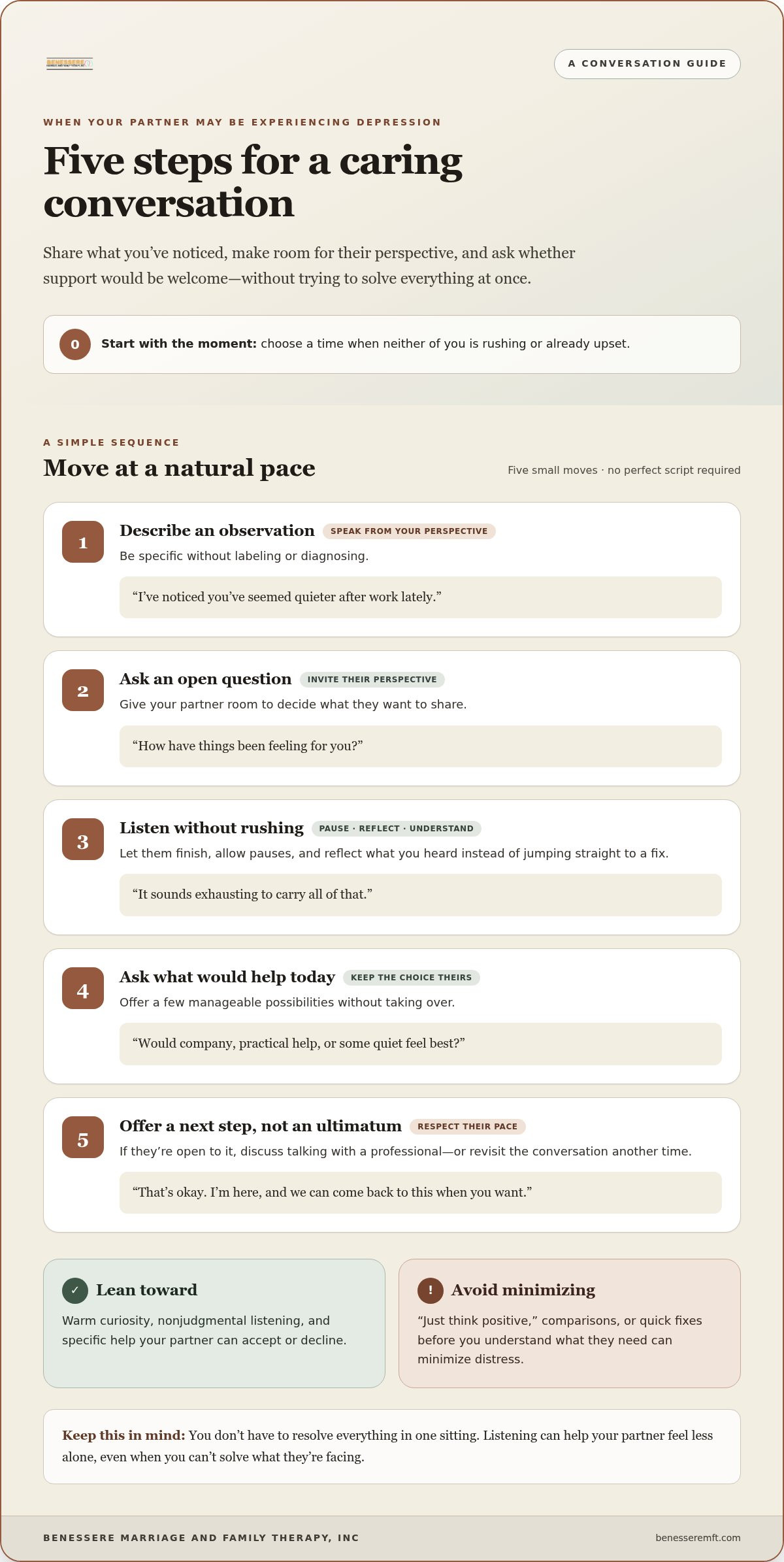
A caring conversation doesn’t require you to know exactly what your partner is feeling or solve the problem on the spot. The aim is to share what you’ve noticed, make room for their perspective, and ask whether support would be welcome. If you’re unsure how to support a partner with depression, a calm, curious conversation is a practical place to begin.
Choose a time when neither of you is rushing or already upset. Then move through these steps at a pace that feels natural:
Describe an observation. Be specific and speak from your perspective: “I’ve noticed you’ve seemed quieter after work lately.”
Ask an open question. Try, “How have things been feeling for you?” or “Would you like to tell me what’s been hardest?”
Listen without rushing to respond. Let your partner finish, allow pauses, and reflect what you heard: “It sounds exhausting to carry all of that.”
Ask what would help today. A manageable question such as “Would company, practical help, or some quiet feel best?” leaves the choice with them.
Offer a next step, not an ultimatum. If they’re open to it, you might discuss talking with a professional or revisit the conversation another time.
Listening can help your partner feel less alone, even when you can’t solve what they’re facing. You don’t need perfect words; your attention and willingness to understand matter. Mayo Clinic also outlines practical ways to support a partner with depression, including listening without judgment and offering assistance.
What to say when you are concerned
Name a change warmly, without labeling or diagnosing: “I care about you, and I’ve noticed you haven’t seemed like yourself. How are you doing?” You could ask, “What kind of support would feel useful today?” Your partner may not be ready to talk. You can say, “That’s okay. I’m here, and we can come back to this when you want.” A pause doesn’t mean the conversation has failed.
What to avoid when offering support
Comments such as “Just think positive,” “Everyone feels this way,” or “You have so much to be grateful for” can minimize distress, even when you intend to encourage. Avoid comparing their experience with someone else’s or offering quick fixes before you understand what they need. Depression isn’t a choice or a failure of willpower. If the discussion becomes tense, take a break and suggest returning to it when you both feel steadier.
You don’t have to resolve everything between you in one sitting. If you both want a structured space to understand how depression is affecting the relationship, couples therapy in Roseville can offer an opportunity to explore the impact together.
Practical ways to support your partner without taking over
Depression can make everyday responsibilities feel harder, but help is most supportive when it responds to what your partner wants. Before stepping in, ask whether they’d prefer practical assistance, company, or someone to listen. Small, specific offers are often easier to accept than a broad “Let me know if you need anything.”
For example, you might say, “Would it help if I picked up groceries, or would you rather choose what we need together?” Offering two manageable options gives your partner room to decide without requiring them to plan the help themselves. If they decline, accept the answer without treating it as a setback or a judgment of your care.
Small offers of help that leave room for choice
Make help an invitation, not a test of motivation. You could offer to handle one shared task, sit nearby while your partner makes a phone call, or take something off the day’s list if they agree. Ask before taking over responsibilities or making decisions on their behalf. Their preferences may differ from yours, so check what feels useful rather than assuming.
Notice effort without measuring it against visible progress. A simple “I appreciate you telling me what you need” can recognize communication without implying that your partner should be improving on a schedule. The goal is to make daily life feel more manageable, not to monitor whether your support is producing a particular result.
“Would you like me to make dinner, or should we choose something together?”
“Would company help while you do that, or would you rather have space?”
“Do you want me to listen, or would it be useful to think through options together?”
Staying connected while respecting their pace
Shared time doesn’t have to involve a big plan or an upbeat mood. Invite your partner to something familiar and low-pressure, such as sitting outside, watching a favorite program, or taking a short walk. Make participation optional: “I’m going to make tea and sit in the living room if you’d like to join me.” Quiet company can be connection, too.
If they say no, accept it without repeated persuasion or withdrawing affection. Leave the invitation open and continue with your own plans. Activities may offer a way to spend time together, but don’t present exercise, fresh air, or a hobby as treatment or promise that it will ease depression. NAMI provides information about depression and treatment options that can help put informal support in context.
Consistency is different from managing your partner. Checking in with care can communicate steadiness; tracking their mood, directing every choice, or repeatedly asking whether they’ve completed tasks can feel controlling. Keep support collaborative: ask, offer, respect the answer, and revisit what helps as needs change. If you and your partner want a structured setting to explore how depression affects your relationship, couples therapy may provide space for that conversation.
Self-care, boundaries, and safety concerns
Supporting a partner through depression can take an emotional toll. Compassion for what they’re experiencing doesn’t require you to ignore your own needs, and setting limits doesn’t make you a bad partner. Sleep, time with trusted people, and support for yourself help sustain care. They aren’t signs that you’re abandoning someone.
There are limits to what a partner can do. You can offer connection and help involve appropriate support, but you can’t control another adult’s choices or guarantee their safety. Knowing what you can offer, and what requires professional or urgent help, can make how to support a partner with depression more sustainable.
Setting limits without withdrawing care
Boundaries describe what you can do, not what your partner must feel. You might say, “I can listen for a while, then I need to rest,” or, “I want to talk, but I can’t continue if we’re speaking to each other disrespectfully. Let’s pause and return to this later.” These limits can be kind and clear. Keep your own trusted relationships, routines, and professional support in view, too.
It’s also reasonable to ask someone you trust for a listening ear while protecting your partner’s privacy as much as possible. Your support doesn’t have to be the only support in the picture.
When the situation feels urgent
If your partner talks about self-harm or suicide, take their words seriously. Listen calmly and without judgment; don’t dismiss what they say or rely on reassurance alone. You can ask directly whether they’re in immediate danger and work to connect them with crisis or emergency support. You are not responsible for managing the crisis by yourself.
In the United States, call or text 988 to reach the 988 Suicide & Crisis Lifeline. If there’s immediate danger, call 911 or go to an emergency department. If you can do so safely, stay nearby while help is contacted, and involve another trusted person when appropriate. These steps can connect you with support, but they can’t guarantee what will happen.
If you’re unsure what to do, treat immediate risk as urgent and seek emergency help rather than waiting for a routine conversation or appointment. Your safety matters, too. If you feel threatened or are in danger, move to a safer place and contact emergency services.
Outside an urgent situation, individual therapy can give you space to consider your own stress and boundaries; couples therapy can help partners explore how depression is affecting their relationship. In Roseville, explore individual or couples therapy as a supportive option, without making it a condition your partner must accept.
When professional support may help, and options in Roseville
There may come a point when caring conversations and everyday support aren’t enough to address what your partner is experiencing. You can gently invite them to consider therapy, share information, or offer to help them think through a first step. The choice remains theirs. You can’t make another adult accept care, and an invitation is not a demand or a test of how much they value the relationship.
For someone experiencing depression, individual therapy can provide a private, structured space to explore what’s happening, consider personal needs, and discuss possible support. Couples therapy offers a different focus: partners can look together at how depression is affecting communication, closeness, and shared routines. It isn’t a substitute for the person’s own agency. It can provide a collaborative setting to understand how depression affects the relationship.
How therapy can support an individual or couple
Benessere offers Individual Therapy and Couples Therapy in Roseville. Treatment planning is collaborative and tailored by the client and therapist, so conversations can reflect the person’s circumstances and goals rather than assume one approach fits everyone. If you’re considering how to support a partner with depression, ask whether they’d like to explore therapy, listen to their concerns, or leave the decision for another time.
Therapy isn’t a promise of a particular outcome, and seeking it doesn’t mean a partner has failed to provide enough support. It can offer a place to consider next steps with professional guidance. If there’s an immediate safety concern, contact emergency or crisis services rather than waiting for a therapy appointment.
Exploring depression support in Roseville
Taking time to learn about care can make the idea feel less unfamiliar. Benessere’s overview of depression counseling in Roseville offers a starting point for understanding support in a local context. Information about individual psychotherapy in Roseville may also help someone consider what individual therapy involves.
These resources can be shared as an option, not presented as an expectation. Your partner may want to read them privately, talk through questions with you, or decide they aren’t ready. Your own needs matter, too. Individual therapy may provide a dedicated space to reflect on the emotional effects of supporting someone you love.
Benessere’s client sessions are by appointment only. Individual Therapy sessions are $190 for 53+ minutes; Couples Therapy sessions are $210 for 53+ minutes. You may request a Good Faith Estimate of expected charges before scheduling. If a bill is $400 or more above the estimate, you may dispute it. In Roseville, learn about Benessere’s therapy services.
Take one thoughtful next step, at your own pace
You don’t have to find the perfect words or carry the whole path forward alone. A thoughtful next step may be a conversation about what each of you needs, a moment to reflect on your own well-being, or an invitation to explore professional support. The goal isn’t to force change. It’s to make room for care, choice, and honest connection.
Learning how to support a partner with depression also means recognizing that support can include space for both people to be heard. Therapy may offer that space, whether your partner seeks individual care or you choose to explore relationship concerns together. At Benessere, therapy draws on evidence-based, trauma-informed approaches, with treatment plans developed collaboratively and tailored to each client.
If you’re ready to consider support in Roseville, explore compassionate therapy services in Roseville. Taking a first step can be quiet and gradual. You and your partner deserve care that respects your pace and leaves room for hope.
Frequently Asked Questions
Is depression a choice?
No. Depression isn’t a decision or a sign that someone isn’t trying hard enough. A person may want to feel better and still find it difficult to take steps that seem simple from the outside. This distinction can help you respond without blame. It also doesn’t mean every action is beyond your partner’s control or that you must accept behavior that harms you.
Can I encourage my partner to get therapy without pressuring them?
Yes. Share your concern and frame therapy as one possible source of support, not a condition for your love or commitment. You might ask, “Would you be open to hearing about what therapy could involve?” If they’re interested, offer to look at information together or let them explore privately; reviewing independent practice sites like sherrywalterscounselling.co.uk can help demystify what qualified counselling involves before reaching out. This approach can help you consider how to support a partner with depression while respecting their pace and decision.
What if my partner refuses help?
You can’t make another adult begin therapy, and repeated arguments may make the subject feel less safe to discuss. Ask what concerns them, if they’re willing to share, and whether there’s another kind of support they would consider, such as speaking with someone they trust. You can revisit the topic later without making every interaction about treatment. If you’re worried about immediate danger, seek crisis or emergency support.
How can I support my partner while maintaining boundaries?
Decide what you can offer consistently, rather than making promises you can’t sustain. For instance, you might be available for a planned conversation but not able to respond to messages throughout your workday. Explain the limit kindly and follow through. Keep activities and relationships that support your own well-being. Boundaries can protect your capacity to care; they don’t require your partner to agree with or feel comfortable about them.
Is couples therapy appropriate when one partner has depression?
It can be appropriate if both partners are willing to take part and want help understanding the relationship’s needs. Sessions can create room to discuss recurring misunderstandings, changes in shared responsibilities, or ways each person experiences the relationship. Couples therapy isn’t a substitute for individual care when that’s needed, and it shouldn’t be used to assign blame or pressure someone into treatment. The focus can be collaborative exploration.
What should I do if depression is affecting intimacy?
Talk about intimacy outside a moment of physical closeness, when neither of you feels rushed to respond. You could share what you miss while asking what kinds of affection, if any, feel welcome now. Intimacy includes emotional closeness and small gestures, not only sex. Consent and comfort matter for both partners; don’t treat affection as proof of love or pressure either person to participate.
Can I support my partner if we do not live together?
Yes. Agree on a form of contact that feels manageable to both of you, such as a brief call on certain days or a message that doesn’t require an immediate reply. Ask before arranging visits or sending practical help, since preferences and privacy matter. If you’re concerned about their immediate safety and can’t reach them, contact emergency services rather than assuming you can assess or manage the situation from a distance.



Comments