
Improving Family Communication: A Restorative Guide to Stronger Bonds
- Eddie Posadas
- Jul 8
- 13 min read

Updated: 4 days ago
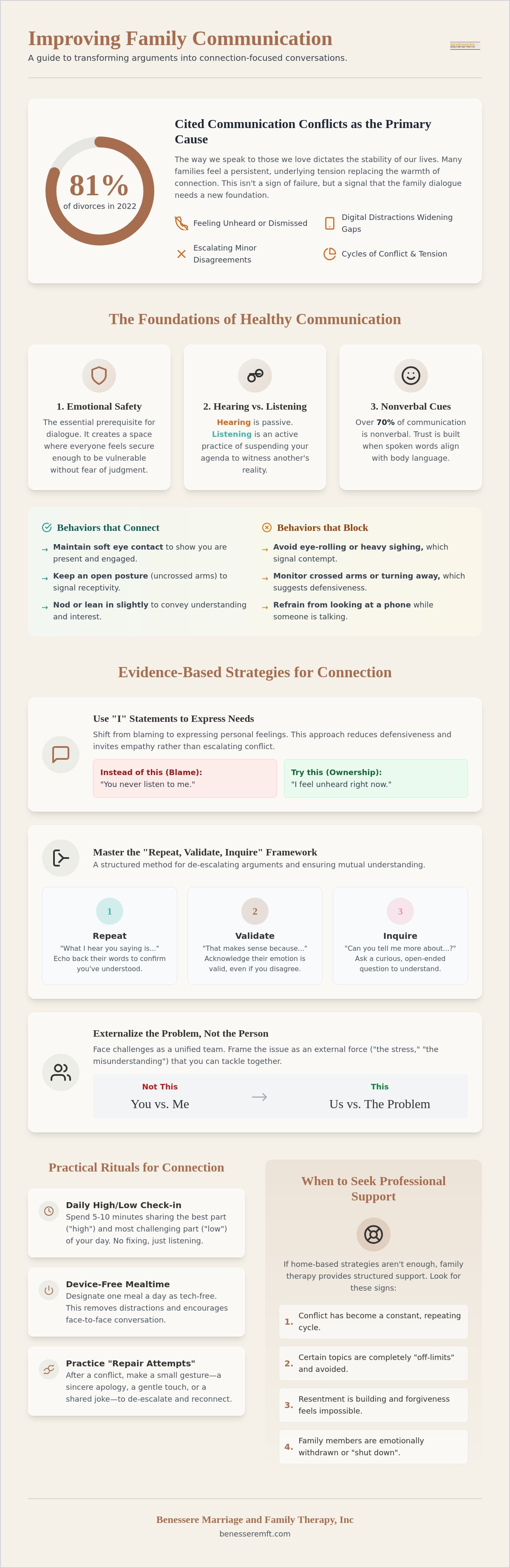
Did you know that in 2022, 81 percent of divorces in the United States cited communication conflicts as the primary cause? This statistic highlights a painful reality many households face; the way we speak to those we love most often dictates the stability of our entire lives. It's deeply isolating to feel unheard or dismissed within your own home, especially when digital distractions and escalating minor disagreements seem to widen the gap between you and your children every day. You aren't alone in feeling that the warmth of your household has been replaced by a persistent, underlying tension.
We understand that these cycles of conflict aren't a sign of failure, but rather a signal that your family’s current dialogue needs a more restorative foundation. This guide focuses on improving family communication by providing evidence-based strategies and practical rituals that transform reactive arguments into connection-focused conversations. You'll discover how to create a calm, safe space where children feel empowered to share their emotions and every family member's needs are met with clarity. We will explore the mechanics of emotional literacy and the specific habits that foster lasting resilience and deeper, more meaningful bonds.
Table of Contents
Understanding the Foundations of Healthy Family Communication
Family communication serves as the vital circulatory system of the home, facilitating the constant verbal and nonverbal exchange of information and complex emotion. To begin improving family communication, we must first recognize that dialogue is not merely the absence of silence; it's a deliberate, collaborative process where the goal is mutual understanding rather than individual victory. This shift from a competitive stance to a collaborative one allows family members to move from being adversaries to becoming partners in problem-solving. When we view communication as a shared journey, the pressure to "win" an argument dissolves, leaving room for genuine connection.
At the heart of this process lies the concept of emotional safety. This state of being acts as the essential prerequisite for any successful dialogue, ensuring that every individual feels secure enough to express vulnerability without the fear of judgment or retaliation. For many residents in Roseville, the external environment often works against this internal peace. The chronic stress of long commutes along I-80 and the demands of high-pressure careers in our local healthcare and technology sectors can leave the family nervous system in a state of high alert. When parents and children return home with depleted emotional reserves, the household environment can inadvertently become a site of friction rather than a sanctuary for recovery. Understanding these foundations of family communication helps us see that conflict is often a symptom of environmental stress rather than a lack of love.
The Difference Between Hearing and Listening
There's a profound psychological distinction between the passive act of hearing and the intentional practice of active, empathetic listening. Hearing is a physiological process, but listening requires the suspension of one's own agenda to truly witness another person's reality. A common barrier to improving family communication is the habit of "rehearsing a rebuttal" while the other person is still speaking. This internal preparation for a counter-argument prevents genuine understanding and signals to the speaker that their perspective is a hurdle to be cleared rather than a feeling to be felt. Healthy families strive for unconditional positive regard, maintaining a baseline of respect and warmth for one another regardless of the current disagreement.
The Impact of Nonverbal Cues on Connection
Research suggests that over 70 percent of our communication is conveyed through nonverbal channels, including tone of voice, facial expressions, and physical posture. Trust is built through congruence, which occurs when your spoken words align perfectly with your body language. If a parent says they're listening while staring at a smartphone, the lack of congruence creates a sense of emotional abandonment. Identifying and removing nonverbal blockers is a vital step in restoring connection:
Avoid eye-rolling or heavy sighing, which often signal contempt.
Monitor crossed arms or turned-away bodies that suggest defensiveness.
Maintain soft eye contact and an open posture to signal receptivity.
Evidence-Based Strategies for Improving Family Communication
Building on the foundations of emotional safety, improving family communication requires a shift from instinctive reactions to intentional, structured strategies. These evidence-based techniques provide the necessary scaffolding to navigate complex emotions without causing further relational harm. When we implement specific frameworks, we move away from the chaos of unplanned arguments and toward a methodical process of mutual understanding. The goal isn't to eliminate differences of opinion but to ensure that every family member feels their perspective is held with respect and care.
Even with the best tools, communication will occasionally falter. The hallmark of a resilient family isn't the absence of conflict but the presence of repair attempts. These are small, restorative gestures, including a gentle touch, a shared joke, or a sincere apology, that de-escalate tension and signal a desire to reconnect. Mastering the art of repair is just as vital as the initial dialogue itself. For those experiencing persistent cycles of disconnect, engaging in Family Therapy can provide the professional guidance needed to refine these skills in a neutral environment.
Using "I" Statements to Reduce Defensiveness
When we use "You" statements, such as "You always ignore what I say," we often inadvertently trigger a fight-or-flight response in the listener's nervous system. The brain's amygdala perceives these as accusations or attacks, leading to immediate defensiveness and emotional shutdown. By contrast, "I" statements focus on the speaker's internal experience, which is much harder for others to dispute. Consider these applications:
For parents: "I feel overwhelmed when the kitchen stays messy because I value our shared space."
For partners: "I feel lonely when we don't talk after work because I missed your company today."
For children: "I feel frustrated when I'm interrupted because I want to finish my thought."
The Power of Reflective Listening
Reflective listening is a core component of improving family communication and is central to the Speaker-Listener Technique. This process involves three distinct steps: Repeat, Validate, and Inquire. First, paraphrase what you heard to ensure accuracy. Second, validate the emotion; it's vital to remember that validating a feeling doesn't mean you agree with the person's logic. Finally, inquire to ensure you've captured their perspective fully. Using bridge phrases like "What I hear you saying is..." or "It sounds like you're feeling..." allows the speaker to feel truly seen and heard.
Practicing Emotional Regulation Before Dialogue
Successful dialogue is virtually impossible when the body is in a state of high physiological arousal. We encourage families to use the "HALT" assessment before initiating a difficult conversation: check if you are currently Hungry, Angry, Lonely, or Tired. If emotions escalate during a talk, a therapeutic timeout is necessary. This isn't an act of avoidance but a deliberate pause of at least twenty minutes to allow heart rates to return to baseline. This pause ensures you eventually respond with clarity rather than reacting out of impulse.
Navigating Conflict and Overcoming Communication Barriers
Even when you've mastered the basics of active listening, you may encounter the most common hurdle in improving family communication: a family member who simply refuses to engage. This silence, often referred to as stonewalling, can feel like a personal rejection; however, it's usually a defensive response to feeling emotionally overwhelmed. When an individual feels that their words will be used against them or that conflict is inevitable, they may choose withdrawal as a way to preserve their own safety. Recognizing this as a protective mechanism rather than a lack of love is the first step toward restoration.
To move past these impasses, it's helpful to establish firm boundaries around how and when difficult conversations occur. This might mean agreeing that certain topics are off-limits after a certain hour or ensuring that discussions only happen when everyone is physically present and focused. When self-guided efforts aren't enough to break these cycles, seeking professional family conflict therapy can provide the structured environment needed to dismantle long-standing barriers and foster new patterns of interaction.
Externalizing the Conflict
A transformative strategy in Narrative Therapy involves externalizing the problem, which operates on the principle that the person is not the problem; the problem is the problem. Instead of labeling a child as defiant or a partner as distant, the family works together to name the conflict cycle itself, perhaps calling it "The Wall" or "The Storm." This shift in perspective allows everyone to stand on the same side of the table and fight the cycle together rather than fighting each other. By externalizing these challenges, narrative therapy helps families rewrite their shared story, moving from a narrative of failure to one of collective resilience and problem-solving.
Managing Digital Distractions and "Phubbing"
In our modern environment, one of the most pervasive barriers to connection is "phubbing," or phone snubbing. This occurs when an individual ignores those in their physical presence to engage with a digital device, a habit that has a documented negative impact on relationship satisfaction. Digital presence often signals emotional absence; it tells those around you that the virtual world is more compelling than the person sitting across from you. To combat this, we recommend implementing specific tech-free zones:
Keep all devices away from the table during meals to prioritize face-to-face dialogue.
Establish a "digital sunset" where phones are put away for the first 20 minutes after everyone arrives home to facilitate a smoother transition.
Designate the car as a phone-free space to encourage spontaneous conversation during local commutes.
Practical Rituals to Foster Long-Term Connection
Building a resilient home environment isn't solely about how we handle crises; it's about the steady accumulation of positive interactions, often referred to as emotional capital. By prioritizing small, consistent habits, you're improving family communication before a conflict even has the chance to take root. These rituals act as a vital buffer against the daily stressors that frequently erode our patience. When a family has a high balance of positive emotional capital, they're much more likely to extend grace to one another during moments of tension.
For those navigating the daily commute along the Highway 65 corridor or managing high-pressure careers in Roseville, the transition from the professional world to the domestic one is a critical window. We recommend the "20-Minute Rule" for reconnection. This involves allowing every family member twenty minutes of low-demand transition time upon arriving home. This brief period of decompression helps reset the nervous system, ensuring that the initial re-entry into the family unit is grounded in calm rather than the carryover of external stress. If you find that the transition into your home remains consistently volatile, reaching out for Family Therapy can provide the structured support needed to restore harmony.
Micro-Moments: Connection in Under 10 Minutes
You don't need hours of free time to foster a sense of belonging. Micro-rituals are highly effective because they're sustainable even during the busiest weeks. Consider these low-pressure activities to maintain your bond:
High-Low-Buffalo: During dinner or car rides, have everyone share the best part of their day (high), the most challenging part (low), and something unexpected or random (buffalo).
The 6-Second Hug: Research suggests that a hug lasting at least six seconds can neurologically regulate family members by triggering the release of oxytocin, which naturally lowers cortisol levels.
Intentional Greetings: Make it a point to stop what you're doing and offer a warm, eye-contact greeting when a family member enters the room, setting a restorative tone for the entire evening.
The Structured Family Meeting
A weekly or bi-weekly family check-in provides a predictable space to address both logistics and emotions. To ensure these meetings don't feel like a punishment or a chore, they should remain positive at least 80 percent of the time. Keep the gathering short, age-appropriate, and follow a simple four-part agenda:
Appreciations: Start by having each person share something they value about another family member.
Logistics: Briefly review the upcoming week’s calendar and responsibilities to reduce future confusion.
Problem-Solving: Address one or two specific challenges using the collaborative frameworks discussed earlier.
Fun Planning: End the meeting by deciding on a shared activity, ensuring the experience concludes on a high note.
When to Seek Professional Support for Family Issues
While the rituals and strategies discussed in previous sections are powerful tools for improving family communication, there are instances where self-guided efforts reach a natural plateau. It's essential to recognize that seeking professional support isn't an admission of defeat; it's a proactive step toward reclaiming the health of your household. When communication patterns become rigid or destructive, a neutral, clinical perspective can provide the necessary leverage to break cycles that have become entrenched over months or years. Professional intervention allows families to transition from reactive survival to intentional, restorative growth.
This commitment to professional standards of communication and accessibility is vital across all sectors, ensuring that every individual's needs are met with clarity and respect. For those interested in how these principles of inclusive compliance and professional practice are applied in broader organizational settings, you can learn more about IntegraSense.
In a therapeutic setting, the focus shifts from simply stopping arguments to understanding the underlying attachments and systemic pressures that fuel them. Engaging in family therapy Roseville CA offers a structured environment where every member's voice is weighted equally. This neutral space allows families to explore complex emotions with scientific precision, guided by a practitioner who can mirror back patterns that are often invisible from the inside. By providing a calm, safe space, therapy helps families navigate their unique stories with both clarity and human warmth.
Recognizing the Need for an Outside Perspective
Identifying when a challenge has transitioned from a common struggle to a clinical "family conflict" is vital for timely intervention. Certain red flags suggest that the family's internal resources are currently overtaxed and require external support. These indicators often include:
Persistent, heavy silence that feels more like a defensive wall than a peaceful pause.
Frequent yelling or verbal aggression that has become the primary mode of interaction.
Children acting out or showing significant behavioral shifts at school or home.
A sense of hopelessness where family members feel that "nothing will ever change."
This need for external guidance is particularly relevant for therapy for blended families in Roseville, where the integration of different histories and communication styles adds a layer of systemic complexity. Having a Wise Guide facilitates these difficult conversations, ensuring the process of improving family communication remains restorative rather than divisive.
The Benessere MFT Approach to Family Wellness
At Benessere MFT, our approach centers on the inherent possibility of growth and the normalization of human struggle. We utilize evidence-based skillsets and narrative-informed care to help families externalize their conflicts and reclaim their collective agency. We don't lecture; we invite you into a collaborative process designed to build resilience and holistic health. Our practice is committed to providing a steady, non-judgmental environment for Roseville residents to navigate their most complex emotional landscapes. We believe that with the right tools, even the most fractured bonds can be strengthened. If you're ready to move beyond reactive cycles, we invite you to explore how our personalized mental health treatment can support your family's journey toward lasting harmony.
Reclaiming Your Family’s Shared Narrative
The journey toward restorative connection begins with a single intentional shift in how we witness each other’s stories. By prioritizing emotional safety and implementing micro-rituals like the twenty minute transition rule, you're actively improving family communication and building a resilient foundation for the future. You've explored how conflict isn't a sign of failure but an opportunity to externalize problems and face them as a unified team. These small, steady changes accumulate over time, creating a household where every member feels safe enough to be vulnerable.
When these cycles feel too heavy to navigate alone, our expert therapists are here to guide you through evidence-based interventions. At our clinical office in Roseville, CA, we offer a restorative, trauma-informed approach to family conflict that respects your unique history and honors your individual story. If you're ready to restore harmony to your home, schedule a family therapy consultation in Roseville today. Growth is a steady, unhurried process, and with the right tools, a more connected household is always within reach.
Frequently Asked Questions
What are the most common barriers to effective family communication?
The primary barriers to effective dialogue include physiological arousal, the presence of digital distractions, and a lack of established emotional safety. When individuals feel defensive, their brain's ability to process information decreases, leading to repetitive cycles of misunderstanding. Additionally, the constant presence of smartphones often creates a state of "phubbing," where family members feel deprioritized in favor of virtual interactions. Addressing these environmental and internal factors is essential for creating a space where connection can flourish.
How can I get my teenager to talk to me more openly?
Encouraging a teenager to share their internal world requires a shift from direct questioning to low-pressure, shoulder-to-shoulder engagement. Activities like driving or cooking together create a natural buffer that makes vulnerability feel less threatening than a face-to-face interrogation. It's also vital to validate their emotions without immediately moving to "fix" their problems. When a teenager feels that their autonomy is respected and their feelings are heard without judgment, they're more likely to initiate meaningful dialogue.
Is it normal for families to argue, or is our communication "broken"?
Conflict is an inherent and healthy part of interpersonal life, provided it's followed by intentional repair. No family is "broken" simply because they experience disagreements; rather, the challenge usually lies in the absence of restorative tools to navigate those moments. When arguments become repetitive, circular, and leave participants feeling isolated, it suggests that the current frameworks for improving family communication are being overtaxed. Growth occurs when you move from avoiding conflict to mastering the art of reconnection.
How do "I" statements actually help in a real argument?
"I" statements serve as a neurological bypass for defensiveness by removing the accusatory "you" that often triggers a fight-or-flight response. When you speak from your own perspective, you're sharing a subjective truth that's difficult for others to argue against. This shift invites the listener to understand your feelings rather than defending their own actions. It transforms a potential confrontation into an opportunity for empathy, allowing both parties to remain grounded and receptive during difficult moments.
What should we do if one family member refuses to attend family therapy?
If a family member is hesitant to participate, you can still begin the restorative process with those who are ready to engage. Change in one part of the family system often creates a ripple effect that influences the entire household's dynamics. By learning new skills and modeling healthier behaviors, attending members can shift the overall environment. Often, the reluctant individual may become more open to joining once they see the positive changes and realize therapy is a safe, non-blaming space.
How much time do we realistically need to spend on communication rituals?
Effective rituals don't require large blocks of time but rather a steady commitment to small, intentional moments. Dedicating just 10 minutes a day to a focused check-in or a brief shared activity can build substantial emotional capital over time. These micro-moments act as a protective layer for the relationship, ensuring that connection remains a priority even during busy weeks. The goal is to create a predictable rhythm of accessibility that fits naturally into your existing household schedule.
Can communication skills be learned, or are some families just naturally better at it?
Healthy interaction is a set of specific competencies that any family can acquire through intentional practice and professional support. While some individuals may have grown up in environments that modeled these skills, the capacity for improving family communication is available to everyone. Learning to regulate emotions, listen actively, and repair after conflict is a developmental process. With the right tools and a commitment to growth, families can move beyond inherited patterns to create their own restorative culture.


Comments